ITOMS
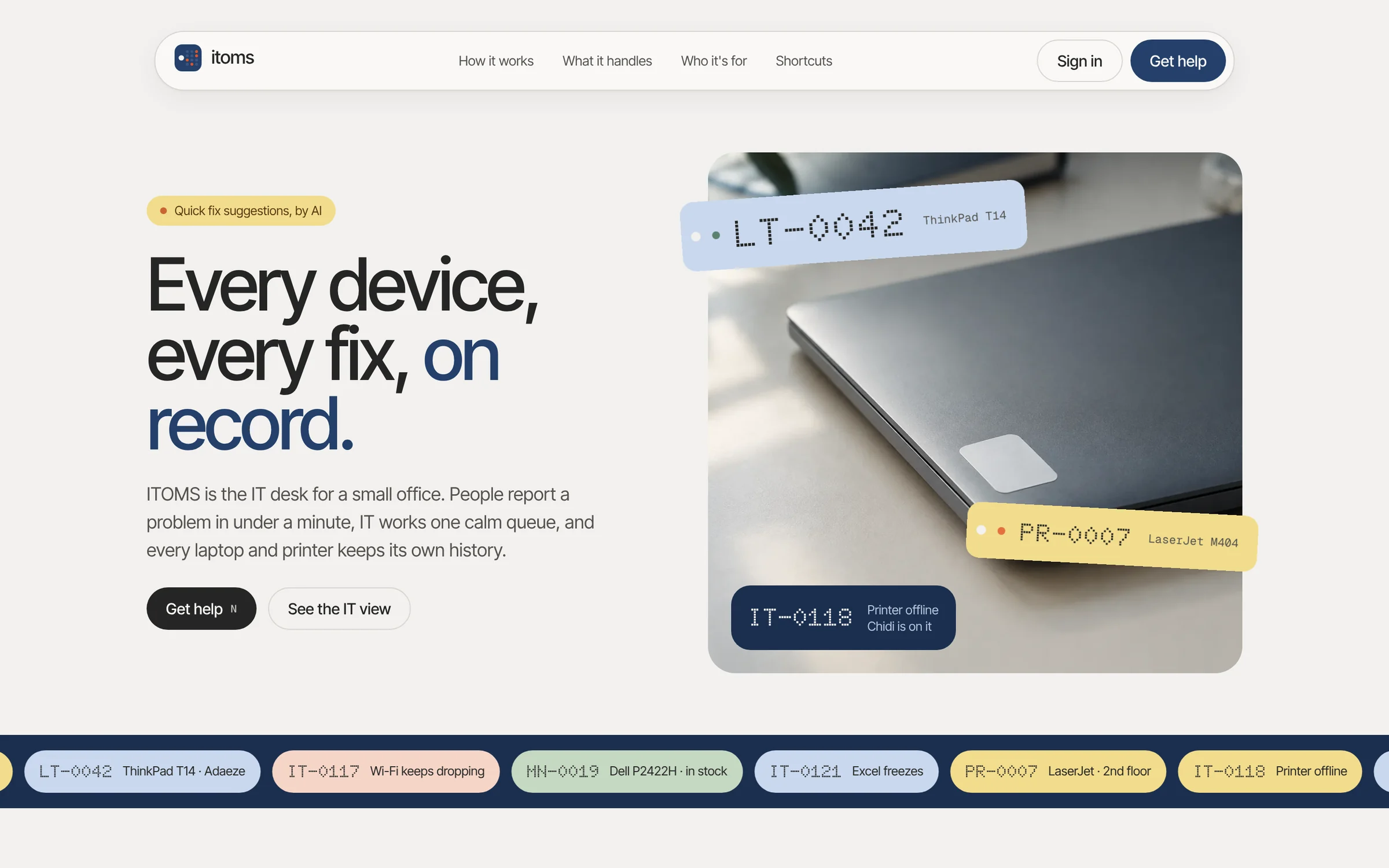
An IT desk for a small office: problems reported in under a minute, one queue sorted by due time, and a history for every device.
Designed it from an IT support internship, then built the schema, the Express API, the three role-based interfaces, the quick fix with its eval sets, the tests and CI, and the 13 decision records.
How it holds together
Step 1 of 6
- Reportunder a minute
- Quick fixGroq → Gemini
- Safety filterzod · unsafe steps cut
- Try the stepsemployee
- IT queuesorted by due_at
- Resolverow lock · history
An employee picks a category and describes the problem. The device they hold is already linked, so they never type an asset number.
The problem
During an IT support internship at a 50-person office in Lagos, requests arrived by walking over, a phone call or a WhatsApp message. Nothing recorded who asked, what was done or how long it took.
Nobody could say which laptop someone held or what a printer had cost in repairs, and the same jammed printer came back every few weeks. Many requests also had a safe first step, like restarting the printer or rejoining the Wi-Fi, that the person could have tried while they waited.
A small IT team loses its week to requests it cannot see or rank. The constraints were real: about 50 users, a few hundred tickets a year, free tiers only, and a build one person could finish and explain.
What I built
Employees report a problem in under a minute and follow it through four stages, confirming the fix themselves. Before filing they can ask for a quick fix: up to five safe steps, or a hand-over to IT.
IT staff work one queue sorted by due time, entirely from the keyboard. Every laptop and printer carries an asset tag, a holder and its own repair history. Admins manage people, devices and change requests.
The architecture
A Next.js web app calls an Express API that runs as one Vercel function. Supabase provides auth and Postgres, and a daily cron closes tickets nobody confirmed.
The rules that must never break live in the database: a partial unique index allows one holder per device and one pending change request, a check constraint refuses a resolved ticket without a resolution, and a trigger keeps the activity trail append-only. The API checks the same rules so it can return clear messages.
The quick fix is one prompt with a validated JSON answer, served by Groq with Gemini as the fallback. A filter strips forbidden steps the model still writes, and every suggestion is stored so IT sees what was tried.
Decisions
Tickets, people and devices are joined on almost every screen and every change writes a history row, so I chose Postgres and pushed the invariants into constraints, indexes and triggers. Putting the one-holder rule in a unique index removed a whole class of race conditions and made the tests simpler.
Stack
- Web
- Next.js 16 · React 19 · Tailwind 4
- API
- Express 5 · TypeScript · zod · pg
- Data & auth
- Supabase Postgres · Supabase Auth · triggers · row locks
- AI
- Groq · Gemini fallback · eval sets
- Quality
- Vitest · Supertest · Playwright · GitHub Actions
- Hosting
- Vercel · daily cron
What it demonstrates
- Invariants enforced in the database rather than trusted to application code
- Concurrency handled with row locks and unique indexes, each where it fits
- A small AI feature with a safety filter and an eval that runs on every change
- Interfaces shaped for three roles, including a keyboard-first queue
- A decision trail of 13 records, one of them corrected in public